Showing posts with label schooling. Show all posts

Saturday, October 9, 2010

63) Dying's Easy, Living's Hard

After four measly hours of sleep and a retake attempt on the SAT today, I started thinking about how hard life really was for students before me. And while I wouldn't like to imagine nuns with rulers, I really don't know what it used to be like.

Both my parents never went to college, so I never hear old-timey school stories. In their native Hong Kong, college was a luxury afforded to those who had the time and money, for public education isn't free over there. It's easy for my parents to take education for granted, seeing as they were hired for work when they were of 'legal' age. They started earning paychecks at sixteen.

From what I could remember as a toddler before I immigrated to the U.S., school in China is a studious mind rape of hell, where you have to learn rudimentary algebra before you learn how to tie your shoes. Ask any student immigrant from Hong Kong and they'll tell you how much more relaxed it is over here in America.

It's not just the subjects and the assigned work. It's the school ethic the kids learn. They realize early on that failure is not an option, lest your teacher display your academic shortcomings in front of the class. They are trained from day one to do what they are supposed to when they are supposed to. Work comes before fun, if they understand the concept of fun at all. Whatever free time remains is devoted to personal research in another academic discipline.

It's this kind of atmosphere that brings up children into productive members of society. And now I wonder what my life would've been like had I stayed in Hong Kong. Would I be more successful? Would I have started working at the ripe age of sixteen? Or would I be valedictorian?

Schooling reflections aside, it's just another aspect of my life that makes things hard. We all deal with it in our own ways. The pressure, the pain, and all the mental and physical harm has made so very tired. Life doesn't get any easier.

Pessimism aside, the point of this reflection was to share my common mantras for living life, no matter how hard it may be. Since I remember them so often everyday:

- Don't speak unless it improves the silence.
- An open mind means being kind.
- It's only illegal if you get caught.
- Sometimes you don't have the luxury of ethics.
- Bend them or modify them, but never go over your limits.
- Everything and nothing are infinite.
- When in doubt, frag out.
- Never fear death; have it fear you.
- No use crying over spilt milk; it could've been beer.
- It's better to have people you know inside pissing out than outside pissing in.
- Nothing is impossible, only improbable.
- Humility saves lives.
- A cornered fox will fight with the ferocity of a tiger.
- Vanity knows karma better than you do.
- Truth is relative.
- One man's war is another person's peace.
- There are times and places for everything...which means you never have that luxury.
- You're not ready to live if you're not ready to die.
- There are more meaningful things in life than complaining about what you can't have.
- Nobody will remember you in a thousand years. Deal with it.
- The meaning of life often involves trying not to think about the meaning of life.

So take out a list and write down your mantras today! You never know; it might make your life easier.

Tuesday, September 7, 2010

57) Forbidden Logic

When you're in a class like AP Computer Science and work with Java, most people have no idea what you're talking about. It falls a bit close to being a racial stereotype in which you only expect one kind of person to understand what the self proclaimed elites call "serious business".

When I tell people about the class, I don't blame them for saying out loud their mental image of a good little nerd pushing their glasses back up and talking in that lisp. We sit quiet and conetnt, even exited as we punch in zeros and ones.

Were it so easy.

One or the other is not how any life works. There are gray areas we understandably avoid for various reasons. The older I get, the more I see ways to creep into gray areas.

My AP Comp Sci teacher told us on day one that the stuff we learned in his class could be used to cause alot of computer harm. Destroy a school network and the like. He made a simple rule:
Use your powers only for good, not for evil.
Me being my military self, its easy to give into my aggressive tendencies for destruction and brute force. I've already thought about doing computer evil a good dozen times already.

Thus we delve into the realm of self-control. One of the few things that separates the old from the young. Can't say that for all people, but everyone knows how easy it is to lose control, especially when you're a young child.

Losing control at school is not a good thing. I've done it before. We all have. It's an outlet for all those raging emotions. I keep telling myself to find an outlet.

My poetry's been on the fritz, as is my writing. I have more time than anybody else I know, and I can't bring myself to produce something more meaningful. If you have the time, get out there and express yourself for a little while in any way you know how. It's good for the soul.

There's this new guitar class at my school that I'm in. Nothing fancy, but I already broke the damn b-string. We all gotta start somewhere. School isn't as bad as it used to be. But then again:

Were it so easy.

Monday, August 30, 2010

55) Bleeding Out

After a first hard day of my senior year, I lost more respect and patience for myself than I ever thought I would. It's a new record.

It was to be expected, the sudden moment of identity shock coming to me as I transitioned from a carefree lazy ass that couldn't be bothered to give a damn back into a slave of the system. The fleeting moments of summer are officially gone, and a part of me would give up my dignity to go back.

The inevitability of the situation did not help. After three years of seeing the same red tile hallways, I knew the teachers and the rooms. I knew where to go and what to do. Regardless, the seniority that I now claim is a bit of a misnomer. We're still just students, and after a summer of fun we barely remember how the system feels.

I found it a little bit funny that my comrade veterans in this education endeavor were still asking questions pertaining to when we got out, or where some of the rooms were. I couldn't blame them for their weary red eyes, but even if I didn't know the answer, I had to act with a bit of professionalism.

And that's when it all came flowing back. The American educational system as a method to turn us into little hopeful workers, striving for CEO. We get close to each other, only for self-interest in advancement. When we get a better grade, we smile devilishly on the inside as we stroke our egos in front of the low-scorers. We don't earn wages. We earn grades.

Along the way, we might even earn a little respect.

But when my respect sours for others on the first day, it's apparent that something is very wrong. I'm very fair and tolerant when it comes to emotional auras, but the disruptive presence of the laughing peer behind me kills my ability to concentrate.

I don't blame him for my first-day dilemmas. There are more important things to consider, like the homework I got from my three advanced placement classes on the first day.

Which is all fine and dandy when parents don't understand why we isolate ourselves from them when we come back home. They seem to have very little empathy when we tell them we can do it later, that our work will get done eventually. We need a few minutes to prevent some emotional suicide after being fed to the hawks for eight hours.

Some people can handle this pressure. Just hope I can. ODST's drop into hell and back in one piece. Here's to hope.

But for God's sake, it's only the first day.

Monday, August 23, 2010

53) To Expect With Confidence

It never gets any easier the older you grow up. It's a fact of life the new generation hates to accept, with all their free time invested in socializing and gaming. Who can blame them? School ain't what it used to be.

On a blistering Monday, nearly ninety degrees in a sun baked courtyard, I waited in line for my books. For my schedule. For my one last refugee of fun and hope to disappear as the summer drew to a close. The heat mocks me.

I took comfort in knowing I'm not alone. We all share the inner instinct to hate the inevitable. By default, that makes you alright with everyone else in line. If you're going to hell, don't do it alone.

Then came the regrets. The things you could've done but never got around too. You try not to blame yourself, but time is merciless in its path. And here, time seems to fall slower, just to torture you into pessimism.

There's something else though. Some inner feelings of...excitement?

That's what the schooling system has done to so many. An obsession to compete against your classmates, an addiction to "learn".

Many before me have tried to fight it, and have matured and moved on. Perhaps one day they might look at their kids and say: "Ha. I can't believe I used to do that. Good luck on your test!".

Sometimes I wonder how many teachers actually believe in the sham of an education system they work in. How often they devote their emotional mindset into genuinely caring for their students. How often they say to themselves: "This isn't right. I have to teach them not to think this way."

So when I see my friends and their smiles, exchanging stories of summer events, I detach myself enough to get lost in a moment of laughter. We all agree on a us vs. them mentality, staring at the teachers. We don't go into hell alone, because we are always there to help each other out on assignments and tests. We know favors count for alot.

Even as I horribly refuse a free drink from my friend because I forgot my wallet, I give in, because we both know I can help him someday, when he really needs that one homework.

I don't believe school can teach me anything worthwhile academically, but I do know it teaches you how to make friends.

Isn't a crap education system worth that much?

Wednesday, March 10, 2010

27) Don't Need No Education

Listen as we honor Corey Haim, rage on the perils of Mr. Sutherland's adolescence revelation, G. Stanley Hall, discuss the injustices of the American education system, Bash the SAT, explain job satisfaction via video games, see how America is stubborn via Exit Signs, and look at Greece's economic woes.

Saturday, March 6, 2010

25) A First Step

Sorry about the sound quality, grammatical structure, and my stuttering.

Monday, March 1, 2010

24) Forced Retardation

Ever since coming across John Taylor Gatto, I've become convinced that the American school system is pointless in teaching kids anything. All it does is force kids into acknowledging their unimportance and inferiority in comparison to others. This fits the role of becoming a capitalist consumer quite well.

As I pondered this earlier in a post, I tired to think of some perfect examples of how this system is so terrible. The list continues to grow for me, especially when it comes to testing and homework. And yet no one would dare dispute that schooling is vital and important. But perhaps that is the greatest joke; the system that teaches nothing is the most important tool in learning anything in America. What we learn is that life will never be fair, opportunities are there if you are willing to stress yourself unnecessarily, and that there shall be no hope for those who wish to conform outside the system.

While trying to study for the SAT, I found it as an important example of this education's idiocy. According to The Princeton Review's 2010 edition of the SAT test prep book, it is stated clearly in the introduction: The test writers say that this test measures "reasoning ability," but actually, all the SAT really measures is how well you take the SAT. It does not reveal how smart or how good of a person you are.

Well that's just great. Why the hell am I supposed to take a test that measures NOTHING? Let's all live in the land of rainbows and sunshine with bunnies going down gumdrop lane. Still a better alternative to wasting my time.

Upon further examination, the introduction also states that the people who compose the test, the EST, are not college level professors or teachers. In fact, most, if not all, have nothing to do with any education system. They're just people who make the test. They even make tests for butchers and professional golfers. Well, nothing could possibly go wrong there.

The solution? Let me quote Caitlin:

Most successful students must work very hard in high school to earn the best grades they can. Students who get extra help, study, and try their best are the ones who tend to get good grades. Their work ethic determines how well they will do in the future. Therefore, a better way to predict students’ college performance is by looking at their ­previous achievements and grades. If colleges focus more on the accomplishments of the four years of high school rather than one test, they will more ­accurately determine how well students will perform in college.

What really bothers me is the fact that I am fully aware of all of this. And yet, I still have to take the test in order to advance into college. I don't have to tell you what it feels like to do something that you know is pointless.

So just how stupid does the American School system think I am? Tell you what: I'd rather not take the test and be called an uneducated fool, but at least I'm not a group of morons who have such blind faith into a failing system. A bunch of morons who spend millions of dollars every year. A group of morons who betray what it means to educate.

Monday, February 22, 2010

23) Fighting Force Majeure

When something becomes mandatory adhering to some status quo of rules and codes, it no longer becomes an activity that you might want to do. This holds precedence, especially in high school, when students are forced to do assignments they do not see the reward in. Day after day, the modern student must struggle against a cause they have no standing reason to believe in.

One such example is creative assignments. This blog falls under that category. Where as some might be able to simply create art on a whim, others must toil through it. Making it mandatory in the name of required "Schooling" effectively makes it that much worse.

Perhaps where I'm going with this is that school seems utterly pointless at an early age. And some may hold that belief true in their later years. But like any effective/ineffective schooling system of the world, we must face facts. The current social belief stands that an education makes a person, regardless of who they may choose to be.

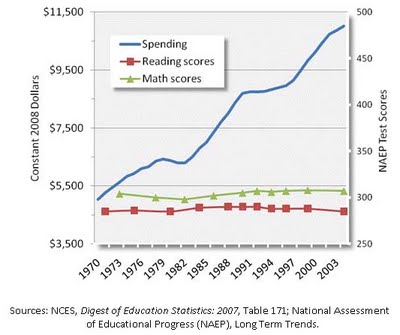
So why does the American school system invest the most in education, and yet rank the lowest in quality students? As Obama pours money for education, many doubt that spending more makes better students.

So you may say that this is another excuse of mine to avoid school? As I recall, the United States of America is a democratic country. Should the students not have a direct say in what they should learn? How much they should receive in funding?

And of course the adults and politicians would declare that we are too young to make such decisions for ourselves. This is a legitimate concern. But what about the young adults? Are they to say our opinions into the matter mean nothing?

Says who? The American society is hell bent on creating the image that an education is the number one priority for a youth. But isn't the youth to decide what they want in life?

And what is the point of all this if they sleep in class, as they do now, if they are not interested in learning something they are forced to? If they have no genuine interest in their lives? The fact that students coin their education "useless" should tell us something. But let me quote John Taylor Gatto, for he says it better:

"The secret of American schooling is that it doesn’t teach the way children learn — nor is it supposed to. Schools were conceived to serve the economy and the social order rather than kids and families — that is why it is compulsory. As a consequence, the school can not help anybody grow up, because its prime directive is to retard maturity. It does that by teaching that everything is difficult, that other people run our lives, that our neighbors are untrustworthy even dangerous. School is the first impression children get of society."

I'm not saying that we should eliminate youth education altogether. But if we can create a system where learning is not a CHORE, it would be a big improvement. A system where people would learn what they want to learn. A system not based on a preset standard that is adhered to only because it is convenient. Only because it is a system that everyone says is effective. Only because it is a system where nobody asks the children what they want. It would really say something about the United State's will for Life, Liberty, and the Pursuit of Happiness.

What I want is not for society to shun a student who decides to quit school because they know their will better than anyone else. That the independence they seek from the tyranny of a failing education system was not in vain, so that one day they may pursue their endeavors in any way they wish, whether it include an education or not.

And most importantly, the idea that you don't need to have an education to enjoy life. Some don't want to spend a tenth of their life confined in being taught the illusion that you can't do anything unless society says you can according to their customs and rules.

Tuesday, January 26, 2010

17) Capacity and Venture

Having enough time to process and ponder The Dumbest Generation from a previous post, I've formulated a theory on why the book is right, even though it's not the premise the book advocates. I respect the book for the perspective it's given me, but I hate it begrudgingly for failing to convince effectively. And if it can't convince a 16 year-old effectively, I don't think it would convince others.

And so I see the folly that proves my theory. The book claims that the younger generation of today is much dumber than the previous, due to their reliance and obsession with modern technologies. But what I see is not lack of intelligence, but a lack of effort.

In the beginning of the 20th century, when standardized schooling become more mainstream in America, the social norms at the time demanded that students learn without resistance. That was a time where you did not talk back to your parents.

By the time World War 2 rolled around, and the GI bill was introduced, education was necessary for success. Colleges and universities became a symbol of a respectable way of life for the American youth.

What do these times have in common that does not exist today? Effort.

In those two times, effort was an asset and not a liability. You had to try hard or realize your failure catching up behind you. There was little argument that the American dream demanded that the young never stop trying to exceed their parents. Social developments and generational shift has loosened the need to try your hardest for the many things that can be taken for granted.

The way I see it, it used to be full effort and little intelligence. Now it's full intelligence and little effort.

These days, technology has diminished the need for effort. You don't need to walk to the library to get a book and read it for a report. You can go online to copy and paste from Wikipedia. The information is easier to obtain, letting technological dependence make us lazy.

I scour the web daily and see insightful arguments in the realms of YouTube and online forums. They go in-depth about the world, ranging from politics to religion.

The problem is that such intelligence stays at the computer. I believe most are now more comfortable expressing themselves in ways that demand the least effort.

Intelligence has not regressed or stopped. It's just being expressed in unprecedented forms. That's why the evidence is more difficult to obtain.

And mostly because we're too lazy to find said evidence.

Monday, January 18, 2010

English Final: Analyzation

Blogger and the overall idea of blogging has changed little about me, even though teachers would claim it is beneficial to my writing skills. My problem is that I don't see whatever improvements I'm supposed to have made. My doubt into this matter is a result of my constant writer's block.

I'm not accustomed to "freedom" writing in school. I doubt many others are either. There are very few writing assignments where you have full flexibility in what you wish to express. This is most likely due to fears of what you can write about in school and get away with. People love to bend this thin line of school ethics whenever they can.

This year, when I decided to take creative writing and required English, one of my main objectives was to defeat my adversary, Mr. Writer's Block. Now I have two classes that force me to do what I am not used to: exercise creative freedom. The number of assignments I have with such flexibility is on the rise. Right now, I'm juggling between blog posts and a few fictional stories I intend to finish.

Such creative independence is daunting. I am not accustomed to freedom over my actions. Most of the time, somebody controls or influences what I wear and eat. In my previous schooling, over numerous assignments, I've always had direction that forced me to work with guidelines.

This lack of dependency now has forced me into an ocean of topics that I hesitate to choose from. It's not because there's so little to work with, but because there is far too much. I don't like jumping into the ocean of creativity without a lifesaver. I often drown.

This is why most of my blog posts are drawn from random moments of inspiration. These are often influenced by others, which I still consider to be guidelines from fake teachers. They indicate what I should write about. These moments are seemingly random, and there is a subconscious response that reminds me I have a post due as an assignment. Sometimes I write these ideas down, and then disregard them later because I deem them stupid or impractical. The one idea I do keep, I write about.

This brings me to my second problem. When I don't discover moments of inspirational clarity, my mind enters a narrow alley. I just want to get the work done and disregard my creative voice. Some may be able to pull ideas out of nowhere on the spot, but the assignments I work on have a deadline. Although it is to be expected, you can't control creativity. I can't pop up with writing ideas at any given moment. My lemon of a brain doesn't like to be squeezed as a last ditch effort to complete homework, especially not the night before it's due.

When I started weekly blogging with YOM, I was enthusiastic about the idea. My first post was a prelude to the great endeavors I would undertake. As time wore on, my idea pool became exhausted, and I began writing ideas without efficiency and thoughtful prose. By the time I got here, my writing style was lacking in terms of language diversity and purpose. I was writing because I had to, not because I wanted to. This still holds true today.

Part of it is that I do some of the blog posts at school, or that I'm simply repulsed with being forced to make ideas out of thin air. My distaste for blogging has grown into an untimely chore rather than an outlet for my spirit. I'm still struggling with writer's block on my blog, along with the overall construction of this entire self-analyzation. The evidence is in my old blog, Shattered Infinity. Writer's block forced me to kill it with extreme self loathing.

When I do write, my current blog follows a trend. I generally just write about media and politics. Everything else falls into the miscellaneous category.

Media is an easy choice for me, as it is for many others on their blogs, obviously because of the impact it has on our lives. My obsession comes with people's interactions with media, and exactly how trends work. More specifically, this goes into the booming video game industry I am so very fond of. This is reflective on the video gamer in me.

Politics is the second fail safe option. It's tempting to write about, but must be done carefully to avoid confusion and criticism, even though both are expected in the final result. I fear the outcome enough to shy away from it.

The bright side on writing about political affairs is that you can relate to everyone on a personal level, as many have a political opinion. Also, you choose who to write about without getting easily stuck. There are many influences to draw from. Barrack Obama is clearly one of the major characters that come to mind. Following my mission statement, I have an inner craving to urge readers of my blog to think more about politics. After all, the government controls many aspects of your life.

Other times, I speculate on combining the two. I often visit www.gamepolitics.com, where I can get inspiration on the two topics that inspire me to write. I've started many hybrids of game politics posts, but they've turned video game posts every time. I hate politics more than I love video games.

I'm dissatisfied with restricting myself to these topics. I want to break the trend, but alas, Mr. Writer's Block has his gun to my head.

If there is anything I learned in the past few months, it's that I should broaden my writing horizons. I'm trying to overcome my fear of writing without being stuck. I've started to save unfinished blog posts and rants instead of deleting them. Looking over them might give me inspiration, and tell me what I shouldn't do when it comes to writing in general.

First, writer's block killed Shattered Infinity. Now it's forced me into a ditch with my current blog YOM. I feel I need to gain some revenge against Mr. Block.

Third time's a charm.

Monday, December 14, 2009

15) Apocalypse How?

Let's face the facts. America is not in a good shape right now. You don't read the front page of the newspaper or watch the local news without seeing some disturbing, convoluted, or depressing image.

And yet here we are, nearing the most holy of days, and the general aura around me seems to be getting sadder and sadder. There is an unspoken, unrealized trend of depression going on, seeping into the very fabric of our lives, dragging us down into the depths of our own private hells.

But who's to blame? You can't really be optimistic when you see the long list of things this current society gets to complain about. There's global warming, the war in the middle east, the destroyed housing market, the collapsed economy, the rising unemployment rate, etc. The list goes on.

I try to remember the happier days, when others around me weren't so grouchy and pessimistic about everything. You could sense the shift from the happier times to the current hell. You might not have seen it, but I did, in very subtle and nearly unnoticeable ways.

Take the slackers for example. There are always a group of people in school that don't do the work, joke around, disrupt class, etc. I always used to think that they really didn't care about their future. But now, I start to question whether they are subconsciously smart enough just not to care anymore. What good does an education do you when the world is ending? Why not laugh it up while you still can? Isn't the guy with no brains and a stable low-paying job worth more nowadays?

I don't really know. All I can know is how to pull through. But if I survive long enough to see the next generation suffer, I can tell them what an idol of mine once said:

If you're going through hell, keep going.

- Winston Churchill


Thursday, November 19, 2009

12) Artificial "Intelligence"

There used to be a segment on the Tonight Show with Jay Leno, called Jaywalking, in which Leno would walk around L.A., interviewing people and asking them basic questions anyone should know the answer to. The humor came from the fact that 20 and 30 year-olds could not tell the audience how many stars were on the American flag, state the first amendment, or who invented the telephone. Of course I understand it's humor, and not a good representation of the average American. But this introduced something else in my mind.

After reading and gutting The Dumbest Generation: How the Digital Age Stupefies Young Americans and Jeopardizes Our Future (Or Don't trust Anyone Under 30) by Mark Bauerlein, I have come to the decision that the title is exactly what it suggests: the newer generation is stupider than the previous. And there is little we can do about it.

Granted, this most likely makes the publishing of the book completely pointless (Which makes him the ultimate idiot), but I understand what he is so paranoid about.

This is the basic premise: the technology age has provided enough opportunities for students to devote themselves to everything else than what matters: an interest in learning.

No student reads Machiavelli's The Prince even though its online. They skim it. And they sure as hell do not read it for leisure.

Let me level with you. As a student, I disagree with Bauerlin because I don't see the advantage of going to school past the 8th grade. I don't understand why I'm going to learn so many things I will never use in my lifetime. The plot of The Cather In The Rye does not help you do the taxes. It doesn't help you get a job. It doesn't pop back up when you are 35 and are working in a cubicle, where reciting its plot details gets you a promotion.

When you hand in your resume, they will ask you whether or not you know how to use Microsoft Word. Not whether you know the British commander at the Battle of Yorktown.

I'm not saying this is to apply in all situations. I'm saying that students learn things they have no interest in learning, and will do nothing for them should the distinct opportunity arise. They simply go online and do a simple copy and paste for assignments in school. They skim passages like you are doing now. Nobody learns anything permanent when they pick up the backpack and leave the door.

Of course I know why. It's much more important to be accepted by your friends when you know more about an American Idol judge rather than a Supreme Court judge. It's more important to update your Facebook page than to read the news. That's just where society has gone.

Is it a bad thing? That's not really for me to decide.

All I really know is that the British commander at Yorktown was George Cornwallis.