Showing posts with label government. Show all posts

Saturday, September 10, 2011

86) Volunteer to Understand

My type of thinking music:


For a friend and my own sanity, I'd like to share with you a glimpse into some of my philosophical beliefs. I'll try to be reasonable (no guarantees).

A) The meaningless of life.

I've always been one to believe that philosophers and people curious about life were always lacking in a meaningful aspect of their lives. Maybe they were just overly curious. It saddens me to know that there are alot of lives in constant turmoil from trying to ask questions they can never really answer.

The longing to know information is very powerful. It can consume people as a dangerous obsession, that being able to understand might grant satisfaction. Luckily, people are smart enough to choose to be ignorant, or otherwise the phrase "ignorance is bliss" would carry little weight.

Which, in the end, explains my somewhat pessimistic view on life, this world, and the people in it. If understanding won't grant satisfaction or bliss, then it's safe to assume that there are simply things not worth understanding. That being said, many things are apt to be meaningless. I'm simply more inclined than my peers to believe that life may be meaningless.

Or to put it another way:

1) There are things we cannot understand.
2) What we cannot understand may be due to its property of being meaningless.
3) Life and existence may be subjectively incapable of being understood.

From 2 and 3:

4) Life and existence may be meaningless.

Let's ignore for a moment the numerous fallacies you could point out in this crude proof. Also notice I left in ambiguity by using the words "may be" in 2 and 3 instead of "is".

It is indeed a grim possibility I've come to believe in. With all the bad about humanity I've seen and written about it, I can't help but wonder if this way of thinking is indeed my own subconscious need for emotional satisfaction by understanding the meaningless behind meaning.

But that would mean that the meaning behind something meaningless has meaning, and I've just stumbled into a vicious regress.

Perhaps instead of fixating on the pessimistic feel of the glass of life being half full, I should wonder where the hell my sandwich is. Or if it exists at all.

B) Conceptional nonexistence.

Imagine for a second that the infinite universe theory is true. That besides our own world and universe, an infinite amount of other universes and worlds exist which account for every possible given scenario and variation. There are other worlds exactly like ours (down to the last molecule and timeline), worlds that are are slightly different (a world where Obama is not the current president), and worlds that are wildly different (filled without physics and inhabited by sentient cupcakes, etc.).

Given that these universes and worlds do in fact exist, we can assume they have validity in their presence and containing structures. In other words, we can assume that their philosophies, laws of nature, and overall meaning, etc. have validity and we would not be prohibited in comparing them to our own reality (assuming this is true, I have just proved validity by simply describing this fact).

In our world, murder is looked down upon (by most) because of ethical and moral standards we've set for ourselves and our societies. It is frowned upon to take a life that is sentient and living because we can associate feelings of guilt and shame for doing so.

Now, imagine another world where the concept of murder does not exist. Killing another person in this world does not have any moral, ethical, or legal consequences. It is as natural as breathing and there are no feelings associated with it. Nobody gains or loses anything from it. It simply is. There is no social stigma against killing. Here, you can choose to chainsaw the guy next to you and no one would even blink.

So from our standpoint, would we abhor killing in this alternate world, even though nobody there has any problem with it? Even though people in that world don't have the concept of murder?

What I'm trying to get at here is that our social rules, ethics, and laws exist according to the society and surroundings we grow up in. If we are taught that murder is wrong and accept that fact, we will regard it as true. However, what's important to understand is that these are concepts. Concepts are ideas that matter only if we give them coherence and existence. As such, morality involving right and wrong exist because we believe they exist.

So what's the problem with that? Concepts are non physical. They are in our minds. Humans simply made them up. There is no rule that says just because we believe in an idea and practice it, it is real and exists in the universe. It does not mean it has a real basis or is meaningful or important. If I tell you unicorns are real, you can believe that concept and give it life and meaning. But that does not mean unicorns exist. You simply wouldn't know. You can just accept it for what it is because it makes you feel better and helps you sleep at night.

The very same applies to morals. We don't follow them because we know without question that the universe tells us they are real and important. We follow them because we made them up and gave them meaning. We all follow them and acknowledge they are real because we believe they will make us happy and ordered. In a sense, all ideas and concepts are fiction. We are the authors, and we decided this is the story we will live by. Writing down the story on paper does not make it any more real if we choose not to give it meaning.

In the end, it might turn out that nothing exists. After all, physicality and existence are concepts. The words you read right now might not mean anything because none it might be real. We can't fathom what existence is because anything we use to describe it might not exist. There is no satisfiable metaphysical way to justify that reality is in fact real.

So in a way, existence does not exist because we have no way of knowing it exists.

My brain hurts. Good thing the concept of pain might not be "real".

C) The infinite marathon of fear.

Given that concepts might not exist, humans can create anything to be happy in reality. With a clean slate, we could imagine and live in a world where anything is possible if we choose to validate its concepts. We can create a society where we worship a color for half a day or require everyone to jump off a cliff when they become parents.

In our society, we have rules and morals that we follow because they make us orderly, happy, secure, and satisfied. However, it is a personal code. There is a different code for every person and society that exists in the world. You might think cursing is wrong, I might think it is right. It all depends on what set of morals and ethics you were raised on. Everyone has their own perceptions on life and how they choose to live it.

There is no hard and fast rule that everyone follows to make themselves happy and emotionally satisfied. We pick the set of rules we know and stick to them because they give us safety and emotional satisfaction. It justifies our lives and our existences. It allows us to have variations and differences of opinion. It allows us to live differently from the person next to us.

How would life be if we all had the same morals, ethics, and rules? A universal way of belief, some miracle truth that allowed us to coexist? Would we all act the same? Would we have eternal peace and harmony?

The truth is that society and its rules are lies, fiction that we create because we need order. It lets us believe that there is a plan, that there is meaning, that we have a purpose. It lets us escape the prospect of nothing. It is our way of defending against chaos. Chaos is uncontrolled, unpredictable, and unstable. Our fear of chaos far outstrips our fear of order.

That is why people begrudgingly accept governments that abuse them. They inherently know that the alternative is worse. Even if we choose to overthrow the current government, the end result is always the same: we simply create another government that was different from the former. It feels natural and safe to organize and order our lives. It is how we survive.

The problem is that it does not work.

Humans are not meant to be organized and orderly. We are animals and savages, no matter how much we pretend not to be. Elevating ourselves to be cultured and mannered to set up societies and governments does not eliminate murder, theft, or war. We create order because we do not trust ourselves. We live lives of hypocrisy and delusion that suppress what we were designed for. Humans are too unstable and random to control their emotions and actions. We are designed mentally and physically to be unable to control ourselves based on what happens around us.

If you are able to look past the rules and order, you will be able to find freedom. You are able to follow instincts and do as your humanity and physiology demands. That chaos is the zeal of anarchy that attracts so many people. Problem is, anarchy does not thrive because the people who fear chaos will always outnumber the people who don't.

To be truly free, you have to get over your fear of chaos and embrace its hold on what you cannot control about anything. You must let go of any fear or impulse against what you are. It is to understand that every controlling aspect about yourself does not matter and means nothing. That nothing might mean nothing. You have to able to embrace the human imperfections that go against your will to survive. You have to be able to accept that the price of freedom is the compromise of your safety. You might die.

Fear not death, and you shall be free.

It is a price many of us are unwilling to pay. It is impossible for many of us to simply unlearn all those centuries of ancestral experiences with law and order. After all, if your parents did not follow society and decided to be free and dead, you would never have been born.

It is my firm belief that the happiness we seek, the eternal satisfaction, lies in that deathly freedom. It is the freedom to do anything without rules or consequences, to accomplish your wildest dreams and fantasies without fear. Why else would I suggest an end to society? We shouldn't need society to restrict our search for bliss.

Regardless of whether you agree with me or not, the argument brings up a good question. What is ultimate satisfaction and happiness worth to you? Is it worth your life?

----------------------------------------

This was all a short glance into my misguided and fractured philosophy. Hope I made you think.

I sincerely thank you for taking the time to understand another person's perspective. If I'm lucky, I'll force you to do something I bet you rarely do:

Challenge your beliefs.

Saturday, July 23, 2011

84) Perspectives of Horror

After finally getting over my summer laziness and deciding to start reading obsessively again, I managed to finish Studs Terkel's celebrated novel, The Good War.

The entire book is an informal collection of interviews Studs Terkel recorded in the decades following World War 2. The interviews flow freely from all different perspectives, including soldiers that were in direct combat from both sides, to regular civilians caught in bombings.

The interesting parts of the novel are in the divisional split of opinions concerning the war. You have shell shocked veterans who will tell you that the conflict was a terrible atrocity that should never be repeated, while another battle hardened soldier will tell you it was the best thing to happen to America.

Of course, many of these opinions have similar backgrounds depicting young gung-ho teenagers with a patriotic streak. Many of them end with horror stories of detached limbs and lost friends.

The book ends with interviews of young children on a Chicago street, their lives no longer looking forward to their lives, but to expect an unnatural death. Although these kids were interviewed at the height of the Cold War, many of their fears still ring true with today's youngsters. The same understanding, the same expectation, still exists.

Children are now raised to be desensitized to violence in the American culture. Although they may not understand the horrors of war in person, they understand better the perspective of death and its inevitability through the world conflicts that occur today. Our culture of death obsession, our fear of the end in relation to war, is vastly different and detached than the views of our grandfathers. With an almost unstoppable flow of images and videos from the nearest battlefield, we now grow up understanding that human suffering is a much more normal and unstoppable condition, rather than being a simple blight of human nature that befalls the innocent. We've grown to understand that it's much more complicated than black and white when it comes to war and death.

But I digress.

The real point, the real moral of this book, is the simple cliche war is bad. It is very bad. Bad along the lines of an H. G. Wells quote stating "If we don't end war, war will end us."

World War 2 was what really changed America into a unstoppable war machine. It spawned the shift from civilian control of the military to the government. It birthed what Eisenhower so famously stated in his farewell speech: the military-industrial complex.

America can't complain. The government really can't be blamed for starting daily wildfires around the globe if the people allow it to happen. At least, that's the idea.

Part of what I've come to understand about American government is that the peoples' mistrust in Washington stems from their lack of control over what goes on. In a democratic republic like ours, we vest our power into representatives that work around the clock in a white building that is a symbol of power rather than practicality. We can't trust that our representatives will comply with any of our requests. When we vote for them, it requires a leap of faith.

Following this form of government, it's not hard to understand how people become upset when their representatives go rogue, and well, don't represent. That's what drives a lack of interest in Capitol Hill for the average Joe. It fuels discontent, mistrust, and anger when the government makes big decisions we have a disturbing lack of control over.

Before World War 2, we could have a say in going to war. There wasn't anything like the Presidential War Powers Act (and the more recent War Powers Resolution) to give the President leeway in deploying troops carte blanche.

What really disturbs me is the real lack of understanding, the lack of knowing just how little control we exert in the decisions that shape whether or not we go to war. All our leaders have to do is pick up the red phone and whisper a single codeword, and the next world war could start. Not long after, a nuke could land on your house and kill you and your family.

Isn't that the real modern understanding of death? Knowing that as an ordinary citizen, you won't live to see tomorrow just because someone at the top disregards your opinions? Is deciding your fate without your consent?

Then again, I did say that electing your representatives takes a lot of faith.

Friday, December 31, 2010

71) Legacy Of The Hopeless


Join us for a long awaited YOMcast as I rant on about America's war in the Middle East, explain a view on Don't Ask Don't Tell, reflect on the past decade of events (video), look at Korea's tension war, North Korea's willingness to open up, and prepare a message for the future...

Sunday, July 18, 2010

48) Amerika

One of my favorite games ever, Fallout 3, hosts a giant, talking robot soldier in the finale, sporting a full arsenal of eye lasers and backpack nuclear grenades. His name is Liberty Prime, and his charm comes from the 60's anti-communist lines he delivers in the heat of battle. It's somewhat comforting to hear a forty foot tall nuclear robot say "Better dead, than red!" when things are blowing up around you. In case you're curious, his soundboard is here.

The robot was built in this alternate timeline world to combat communist China, but nuclear Armageddon cut those plans short, stranding Liberty Prime inside a bunker under the Pentagon. His appearance as your ally is a liberating comfort that ushers you into a satisfying ending to the game.

But more importantly, Liberty Prime is the game's personification of American anti-communist fears. Even today, communism carries a negative connotation, perpetrated by the victorious and democratic United States after the Cold War. Marx and Engels' legacy has been driven to a slow and painful death, the last embers flickering out in this modern world.

That said, we can still remember the resounding echoes of the Red Scares, or the rampant fears created by McCarthy in the past century by those that were there.

This all leads up to the story of my grandmother. She's no Liberty Prime, but she knows how to blow your head off with a rifle. Born during World War Two, she's survived the Japanese invasion of China, the Chinese Civil War, and the Cultural Revolution of Mao. Hardly a soft-spoken woman in old age, she continues to have the loudest voice in the entire room. People often regret making her angry.

She's worked as a farmer, an assembly worker in a radio factory, and no doubt many other occupations she's never mentioned. These days she lives in the United States, residing in a comfortable apartment in Oakland, California.

Like any other sagacious grandparent, she likes to impose on us her stories of experience, hardship, and secret. She hardly ever mentions anything about Communism, and I've always found it odd that her struggles for money in China never came up as a true complaint. Besides, back then you could be shot for celebrating Mao's death.

As I listen to her complain about the United States and its injustices, I can't help but think that she envies her old life back in China. Of course, she came over here for a reason, but old age and finances might prevent her from going back. I'm sure there's much more to her hypocritical complaints, but it probably justifies her being terrified during the recent Oscar Grant riots, which reached to a block from her building.

She doesn't have alot of time left, maybe a decade or two, and I can't help but think that another memory of communism will die with her, whether its a good memory or a bad one. This extends to my family on both sides, many of whom still reside in China.

I can't tell you whether or not communism is good or bad, but everyday we lose another impression of it with the death of the old. Books can only tell you so much about what it was like. We can't truly relive their memories, so I guess it really won't matter in the long run.

However, Communism is an idea, and some ideas can never die.

Who knows? Maybe when I die, democracy will die with me.

Thursday, July 15, 2010

47) Scr(ew)ooge's Paradise

By nature, America is always economically associated with capitalism. Everyone knows that the biggest manufacturers will sell there, eager to make a quick penny over the most devoted of consumers. No product is too ridiculous, for someone, somewhere, will buy it.

Capitalism and consumerism is such a vital core of American life that it controls everything, from food to clothing. Starbucks, McDonald's and Nike are some example brands alot of people cannot live without. Most people can't realize just how valuable and nostalgic local businesses are these days.

The American dollar holds such value that it cannot be labeled unnecessary. As the United States grew, not only did we lose the concept of "money isn't everything", but we also lost the value of what money means to a human being. A government gets to decide that value.

It's logical to assume that the American lack of frugality is founded in the deep nationalism set by Uncle Sam. Spending defines alot of what it means to be an American, provided that you don't immediately go bankrupt afterward. After World War Two, what else could suburbia do?

This is all further reinforced by a natural hate of socialism and communism by America at large, who have an ironic audacity to complain about civil rights. Not the same you say? In America, what would you rather take: A million dollars, or fair treatment?

Truth is, you'd want both, and that's why consumerism is smiling at you. Granted, not everyone is driven by blind greed, but often there is a consensus of "more is better". Can't say the death of Crassus is something to be admired.

Charities try to upset the sad imbalance for the poor, giving money to those who can't make it on their own. It is a glimmer of hope that requires a sympathy and guilt shock when humanitarian agencies have to advertise images of dying children to get your attention.

So think, my friend, the next time you are stuck in a precarious situation of greed, given the American status quo. Which is more important to you: money or ethics?

And no, you can't have both.

Wednesday, July 7, 2010

46) Independence Galore

I've been working on my summer assignments for AP Government, so might as well post my opinions on here:

A failing economy, an oil spill crises, and a seemingly never-ending war are just a few things the American people have to deal with on a daily basis. The anger and disappointment in the U.S. government’s quick resolution to these issues is growing more apparent by the day. There are so many discontent citizens willing to turn to new and radical ways to satisfy their understandable desires for change. This is why President Obama was elected. Everyone believed he could solve our problems on a tight schedule, and we reeled in disgust when his administration disproved the apparent myth that they could make us happy and content.

This is why it’s no surprise that the seemingly ageless rule of Democrats and Republicans of the past century is coming to a possible end. With the current situation worse than anybody could have ever predicted, people are tired of the endless debate and bipartisan horseplay present in the Senate. They demand results now, because for some Americans, lives are literally on the line. The tide is turning for Independent candidates to work in Washington, unrestrained by political assumptions and party stereotypes.

The new generation requires a change ready to match the magnitude of their problems. Hope rests behind people like Charlie Crist, Eliot Cutler, Tim Cahill, or Lincoln Chafee. Whether they’re running for Governor or the Senate seems irrelevant; as long as they gain a voice in the higher authority of the United States, that’s all that matters. Could whole states turn away from their political benefactors for the sake of change? Only time will tell.

Soon we shall see whether this trend can gain enough momentum to sustain itself past infancy. If the people demand it, then the current government shall truly be afraid of its constituents. My hopes lie in the possible prospect of an Independent president. This dream may be centuries away from reality in American history, but we must not forget that even our nation’s first president had certain dislike of bitter partisanship. This may all be the start of a new era in American politics.

Monday, June 14, 2010

42) Home of the Brave

Writing your congressman/senator or appearing at town hall meetings is a political exercise many young students go through to understand the American democratic process. It is the point of inspiration for many aspiring students that wish to succeed in government someday.

However, the public and the media often forget that these figureheads of government are still human. We hold these idols to a high expectation of leadership and heroism, destined to make change for the better.

We understand the high profile world that these representatives are embroiled in. We see stories of their sexual escapades, their sudden lapses of intelligence, or their public outbursts of politically incorrect statements.

The media that paints this image always exposes the drama that runs through their lives. Most recently, CBS scored a hit with their series The Good Wife, which explores a lawyer's tumultuous life after her husband's political career goes awry with infidelity.

Everywhere you go, there's always someone who loves to expose the government and its puppets for what they really are: manipulative control freaks who are irreparably corrupted and ethically ignorant in the name of representation and control.

So when some students catch a congressman at a bad time and film him, there are bound to be interesting results:


(Alternate link if the above doesn't work for you)

It's a hot debate as to who's right or wrong here, even though it's obvious that the students can play the harassment card.

I call it a debate for several reasons:

1) The senator will issue a public apology and get away with it. There is a 0.0001% that he will resign as a result of this video.

2) The students will lose a harassment lawsuit against the congressman, should they choose to file one.

3) Public exposure to the video will be minimal at best.

My thoughts?

I've always been a fan of the theory that the American government is always decades behind the societal changes that occur in the United States and in the world. This is why it took so long to elect an African American president, or why the ethnic minorities in Congress are grossly unrepresentative of the public at large.

It allows this hypothesis to be drawn: The ruled and the rulers are separate entities that shall never coexist peacefully.

While Washington D.C. is steeped in centuries old tradition of cutthroat politics, the public is utilizing technology to share ideas on how they want things to be done.

It's the friction between the two halves of this America that make the system a miraculous display of continuous function for fear of anarchy.

As we delve into tougher times, more personal sacrifices are required to keep the American machine running. This requires the superhuman strength that we expect from the politicians that hit students on the streets. It's time for the media myths of leadership to take fruition.

All the while, the public can continue to lose themselves in watching another season of reality shows and Youtube memes, oblivious to the problems that they don't have to deal with. Leave it to the politicians, they say.

Who knows? Maybe America has earned its dishonorable death.

Monday, May 10, 2010

Lit Circle Letter 2: World War Z

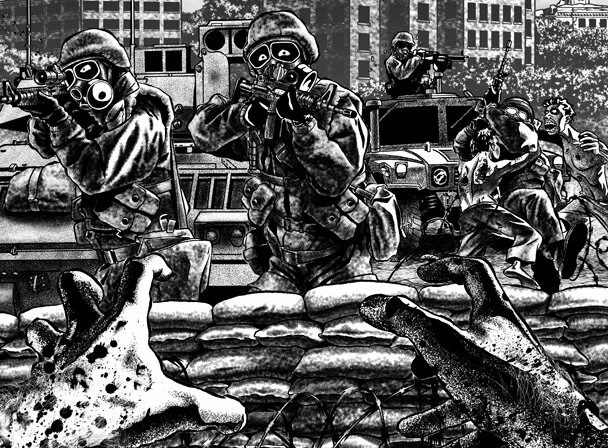
The second third of World War Z deals thoroughly with the stabilization that humanity faces in their terrible and desperate war against the undead. We see stories of incredible suffering, death, and destruction as people attempt to fight back against the walking corpses.

This section is also a deep insight on how humanity changes in dire times. It is thorough this change that we see the extreme ends of human nature, ranging from cowardice and fear, to strength and bravery. It also reveals the distinct qualities of the current world superpowers. It is these qualities that make or break a nation in this hypothetical doomsday scenario.

There is a deep and striking interview that gives insight into the class structure of America. It is the division between the day laborers who get their hands dirty and earn little, to the high and mighty CEO's that sit comfortably at their desks. In a zombie apocalypse, the CEO's are pointless when it comes to survival. An interview with the manager of the rebuilding program in the war torn American explains it quite well:
Yes there was racism, but there was also classism. You're a high-powered corporate attorney. You've spent most of your life reviewing contracts, brokering deals, talking on the phone. That's what you're good at, that's what makes you rich and what allowed you to hire a plumber to fix your toilet, which allowed you to keep talking on your phone. The more work you do, the more money you make, the more peons you hire to free you up to make more money. That's the way the world works. But one day it doesn't. No one needs a contract reviewed or a deal brokered. What it does need is toilets fixed. And suddenly that peon is your teacher, maybe even your boss. For some, this was scarier that the living dead. (140)
And isn't this the ultimate symbolism for the American elitist society? With the growing dependence on technology and other forms of life easing methods, less and less people are turning to menial labor to get things done. What isn't being considered is what happens when these things are suddenly taken away, or when they no longer work. What happens then?

In a way, it a sort of secret slavery that goes on. Money is the one big controlling factor here, and people don't mind digging through mountains of garbage if they are paid millions. And some don't even consider that because they find it degrading and insulting. Why do it when you can hire someone else to do it for you?

Not only is it laziness, it's also stroking the inner ego when it comes to living in America. This is not to say every person who hires others to do their dirty work is bad. They might honestly have no experience in that area of work to do it themselves. The factor I'm trying to address here is whether they would be willing to learn the trade given the circumstances. Whether they would be willing to swallow their pride and show some humility if it means surviving.

It goes deep into the psychology of the average American when it is truly put to the test. World War Z explains what people are willing to do or not do in Armageddon circumstances. In the context of the American government, it is the test of morals. The fictional former American vice president can testify:
So many of his proposals looked crazy at first glance, but once you peeled back the first layer, you realized that underneath there existed a core of irrefutable logic. Take the new punishment laws, those really set me off. Putting people in stocks? Whipping them in town squares!?! What was this, Old Salem, the Taliban's Afghanistan? It sounded barbaric, un-American, until you thought about the options. What were you going to do with the thieves and looters, put them in prison? Who would that help? Who could afford to divert able-bodied citizens to feed other able-bodied citizens? More importantly, why remove the punished from society when they could serve as a such a valuable deterrent? (149)
Notice the words "un-American" and "barbaric". The truth is that practicality is valued much more than morality when the end is nigh. This isn't just a societal shift in thinking due to circumstance. The real world away from this fictional zombie apocalypse has countries that look down upon each other because of the clash of ethics and morals. This is why the world can never fully cooperate, even if you take the Armageddon situation out of the equation. It's just human nature.

One of the resulting ironies of this "practical government" thinking manifests itself quite clearly in Word War Z. Because of the zombie invasion in mainland America, many survivors flock to Cuba for its natural defensive capability as an island. This results in the economically weak island nation to become one of the most successful market economies after the war's conclusion. It is perhaps the greatest criticism and insult of American government, while eerily mirroring it:
Of course our new Latin superpower is anything but idyllic. We have hundreds of political parties and more special interest groups than sands on our beaches. We have strikes, we have riots, we have protests, it seems, almost every day. You can see why Che ducked out right after the revolution. It's a lot easier to blow up trains than to make them run on time. What is it that Mister Churchill used to say? "Democracy is the worst form of government, except for all the others." (233)
Superpowers being anything but idyllic: the notion of no perfect society, even if it is powerful. This is America. Hundreds of political parties and special interest groups: America. Daily strikes, riots and protests: America. A lot easier to blow trains than to make them run on time: America in the Middle East. "Democracy is the worst form of government": addressing the preconceived notion that democracy is the best form of government.

Let me remind you that the need for democracy has cost the world several million people in casualties in assorted wars. The current American government is what dragged America into the Middle East.

Alas, praise the political undertones that a simple zombie book can give you.

Tuesday, May 4, 2010

Lit Cicle Letter 1: World War Z

World War Z by the infamous zombie author Max Brooks delves deep into a nightmarish scenario of a world engulfed in war with the undead. The book is written in the style of Studs Terkel's The Good War. The entire story is told through interviews with people involved in the war in different places and times. The interviews all take place after the war has happened.

This seems to be a mindless horror fiction book, but many underlying messages and themes can be found early on. As the stories of the interviewed are told, we see more and more about the panic, the chaos, and the sheer hopelessness of their situations. If anything, the entire book is a hypothetical account of what would occur if the world faced a major crisis.

Skepticism at the undead is the main focal point for the first section of the book, easily shown by the people who were there. From an former intelligence agent, this is infused with political commentary:
No matter how unlikely or far-fetched a possibility might be, one must always dig deeper. If a neighbor's nuclear power plant might be used to make weapons-grade plutonium, you dig; if a dictator was rumored to be building a cannon so big it could fire anthrax shells across whole countries, you dig; and if there was even the slightest chance that dead bodies were being reanimated as ravenous killing machines, you dig and dig until you strike the absolute truth. (34)
The agent's story holds true to the modern day intelligence agencies of the world superpowers. It is a clear description of what can be inferred from a world crisis. The fictional director of the Central Intelligence Agency can testify:
If your Soviet neighbor is trying to set fire to your house, you can't be worrying about the Arab down the block. If suddenly it's the Arab in your backyard, you can't be worrying about the People's Republic of China, and if one day the ChiComs show up at your front door with an eviction notice in one hand and a Molotov cocktail in the other, then the last thing you're going to do is look over his shoulder for a walking corpse. (47)
Or maybe the former White House chief of staff:
We got dozens of these reports a week, every administration did, claiming that their particular bogeyman was "the greatest threat to human existence." C'mon! Can you imagine what America would have been like if the federal government slammed on the brakes every time some paranoid crackpot cried "wolf" or "global warming" or "living dead"? Please. What we did, what every president since Washington has done, was provide a measured, appropriate response, in direct relation to a realistic threat assessment. (59)
Political satire much? What's being done here is the taking of a hypothetical world crisis and imagining what the response would be from every last government on Earth. In the process, we can isolate and insult the problems present in the government of any country.

But then again, this is a fictional book. It's interesting to try and identify whether this book is a clever commentary on world governments and human nature, or just another story about zombies. I say its both.